Short answer: A pool safety fence should separate children from the pool while still allowing practical access and everyday use of the backyard.
There is no single fence layout that works for every backyard. Pools, patios, doors, landscaping and outdoor living spaces are all different. That is why deciding where your pool fence should go deserves just as much thought as choosing the fence itself.
Here are the most important things to consider.
Start With the Main Goal: Separating Children From the Pool
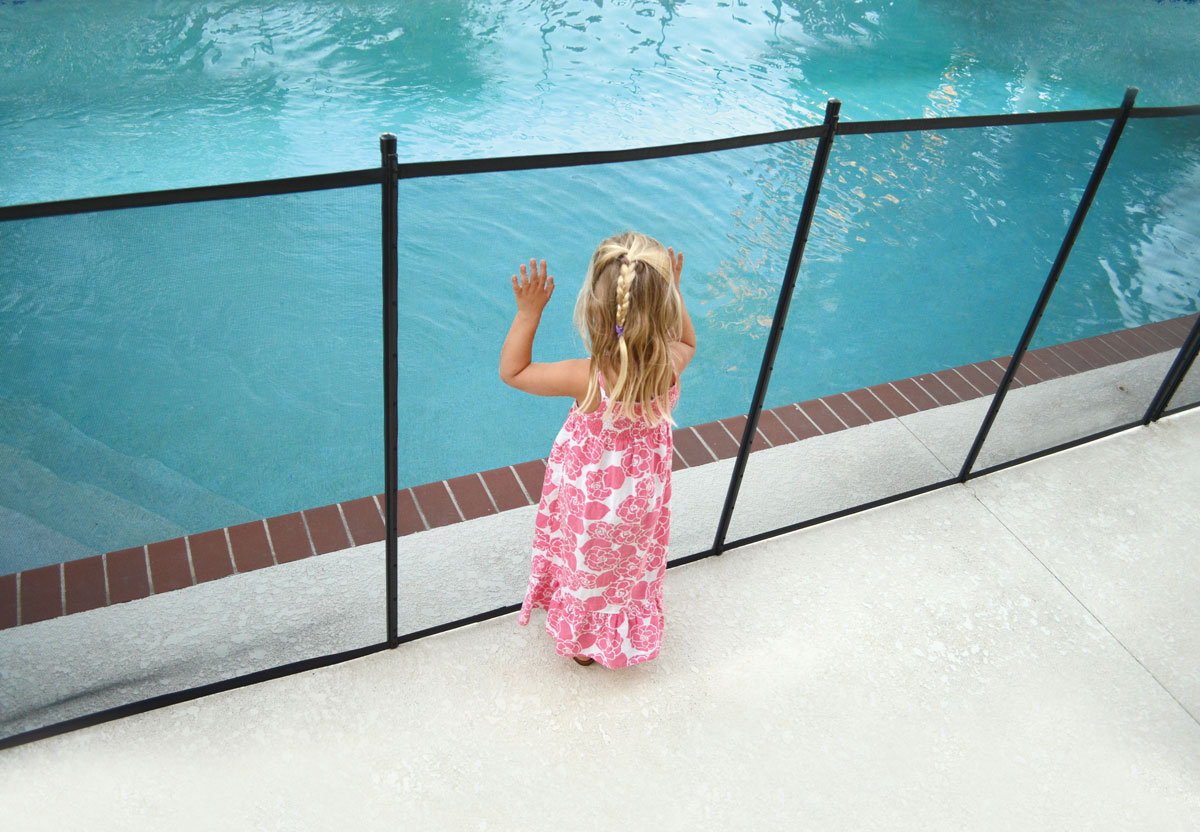
The first priority is creating a physical barrier between the pool and the areas children can access.
Look at your backyard from a child’s point of view. Which doors lead outside? Where do children play? Can someone leave the house and reach the pool without encountering the fence?
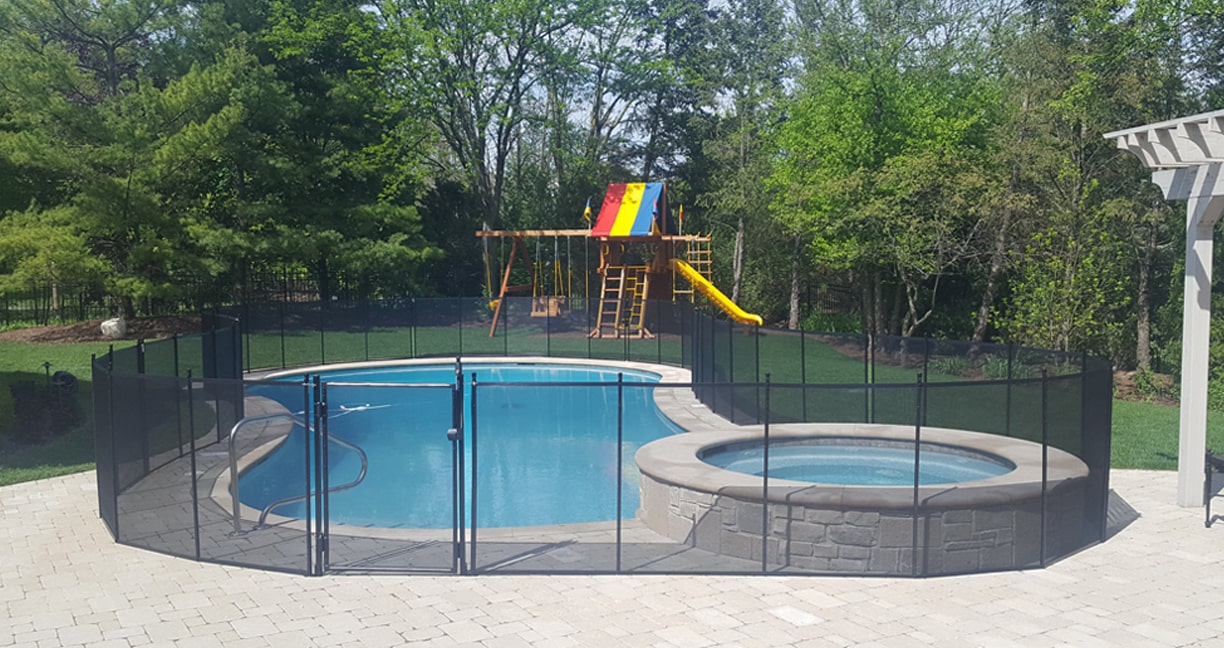
In many backyards, the most effective approach is to surround the pool so the fence separates it from both the home and the rest of the yard.
This is often called four-sided isolation fencing. The American Academy of Pediatrics recommends four-sided fencing that completely separates the pool from the house and yard, rather than using the home itself as one side of the barrier.
A pool fence is still only one layer of protection. Active adult supervision remains essential whenever children are in or around water.
Think About How Your Family Uses the Backyard
Safety comes first, but a good fence layout should also work in everyday life.
Think about the parts of your backyard you use when you are not swimming:
- Do the kids play on the lawn?
- Do you regularly use an outdoor dining area?
- Is there a grill or outdoor kitchen?
- Do you need a clear path from the house to another part of the yard?
- Where do guests usually gather?
Whenever possible, keep frequently used areas on the non-pool side of the barrier. This lets your family enjoy more of the backyard without needing to enter the fenced pool area.
The goal is not simply to draw the smallest possible line around the water. It is to create a layout that provides an effective barrier while making sense for your family’s normal routine.
Minimize Unnecessary Trips Through the Fence
Another useful rule is to avoid placing the fence where adults will constantly need to pass through it.
If the grill, patio table or main backyard walkway requires you to go through the pool fence every few minutes, the layout may become inconvenient.
Instead, think about which areas need to be inside the pool enclosure and which can remain outside it.
A well-planned layout can make the pool a distinct area that you intentionally enter when it is time to swim, rather than making the fence something everyone has to navigate throughout the day.
Decide What Belongs Inside the Pool Fence
Not every pool needs the same amount of space inside its fence.
Some homeowners prefer the barrier relatively close to the pool so they can preserve as much patio and play space as possible outside it. Others want additional room inside for lounge chairs or other poolside activities.
Consider what you actually want to do inside the fenced area.
If furniture will remain inside, its placement deserves special attention. Chairs, tables, planters, storage boxes and other objects should not create an easy climbing aid next to the fence. As we explain in our guide to whether a child can climb a mesh pool fence, the area surrounding the barrier matters too.
Choose the Gate Location Carefully
The gate is one of the most frequently used parts of a pool fence, so its location should be deliberate.
Ideally, it should provide convenient access to the pool without turning the pool enclosure into a shortcut between other parts of the backyard.
Think about the route someone will naturally take from the house to the pool. A trained installer can help determine a gate location that provides practical access while maintaining the intended barrier.
Protect-A-Child offers purpose-built self-closing pool gates with key-lockable magnetic latches and spring-loaded self-closing hinges. Even with a self-closing gate, homeowners should always verify that the gate has completely closed and securely latched after passing through it.
Your Fence Does Not Have to Form a Perfect Rectangle
Many homeowners assume a pool fence needs to run in straight lines around a rectangular area.
It doesn’t.
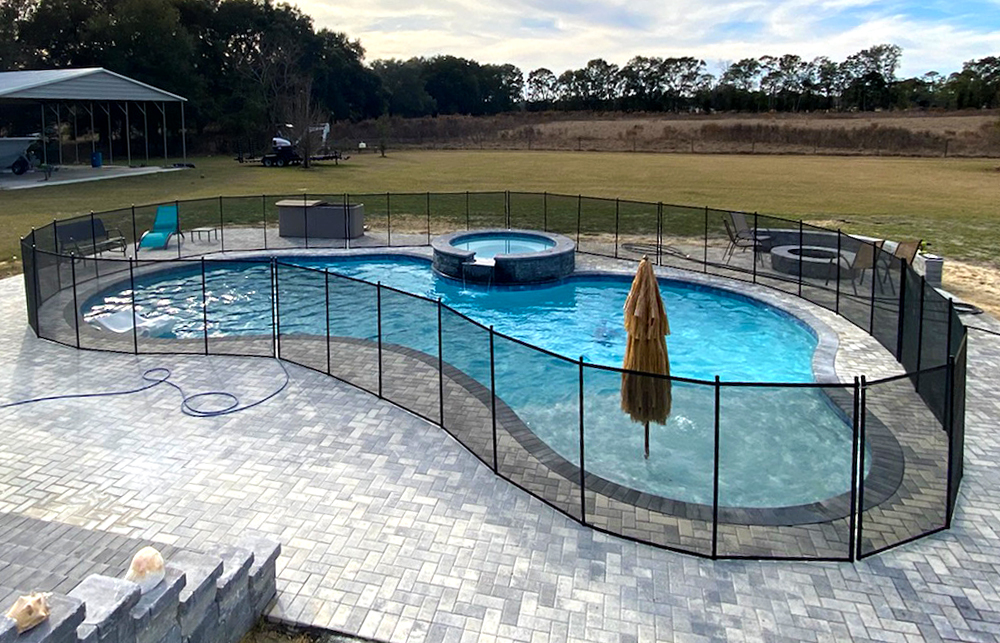
A professionally installed removable mesh fence can be custom-fit to follow the needs of the individual pool area, including curves and unusual backyard configurations. PAC’s current pool fence system is designed for custom layouts rather than forcing every pool into the same basic enclosure.
That flexibility can be especially helpful around freeform pools, spas, landscaping and patios where a simple rectangle would sacrifice useful backyard space.
Don’t Forget Doors and Other Access Points
When planning the fence, look beyond the edge of the pool.
A beautiful layout is not very helpful if there is still an easy route from the home or another child-accessible area directly to the water.
Consider:
- Exterior doors
- Sliding doors
- Side-yard access
- Garage access
- Play areas
- Outdoor structures
- Other paths children could use to approach the pool
The purpose of the layout is to establish a meaningful barrier between children and the water, not simply to put fencing near the pool.
Leave the Final Layout to the Actual Backyard
It is useful to sketch out where you think your fence should go before requesting an estimate. But you do not need to solve every detail yourself.
A professional installer can look at your pool, deck, home access, traffic patterns and outdoor living areas together and help determine a practical fence path.
Protect-A-Child fences are professionally installed by trained local dealers and custom-fit to the individual pool area. Professional installation also helps ensure the posts, mesh, access points and gate work together as the barrier was designed to function.
You should also check the pool-barrier requirements that apply in your jurisdiction. Requirements can vary, and a particular layout should not be assumed to satisfy every local code simply because it works well in another backyard.
The Best Pool Fence Layout Balances Safety and Everyday Use
So, where should a pool safety fence go?
Start by separating the pool from the home and areas children regularly use. Then consider your patio space, normal walking paths, gate location and the way your family uses the backyard when nobody is swimming.
A thoughtful layout can create a clear physical barrier around the pool without unnecessarily giving up the rest of your outdoor space.
If you’re considering a removable mesh fence, explore the Protect-A-Child pool fence system or request a free quote to have a trained local dealer evaluate possible layouts for your pool.